In communities where formal employment is scarce and university education is not always the right path, vocational and technical skills represent a credible, dignified route to economic independence.
The Peter and Margaret Nwomeh Foundation has invested in this path since its earliest years — and the story of how we got here is itself worth telling.
Our skills-training work sits at the intersection of opportunity and practical support. We do not simply point young people toward programs. We identify the opportunity, negotiate access, cover fees and transport, and follow up to ensure the investment lands.
The Foundation’s first youth-scale training initiative was the Youth Enterprise Grant program. In 2023, five young people from Ozalla submitted business plans — for piggery farms, fish farms, and ginger-juice production — and the Foundation awarded ₦200,000 grants to each, a combined ₦1,000,000 in first-installment funding.
These were not handouts. Recipients were selected on submitted plans, given the capital to begin, and asked to submit progress reports by year’s end. The expectation was accountability: that the funds would go where they were said to go, and that the community’s investment would be honoured.
It was a direct bet on young people with a plan and the drive to execute it. That bet — on productive capacity, not just need — is the animating idea behind everything the skills-training program has become since.
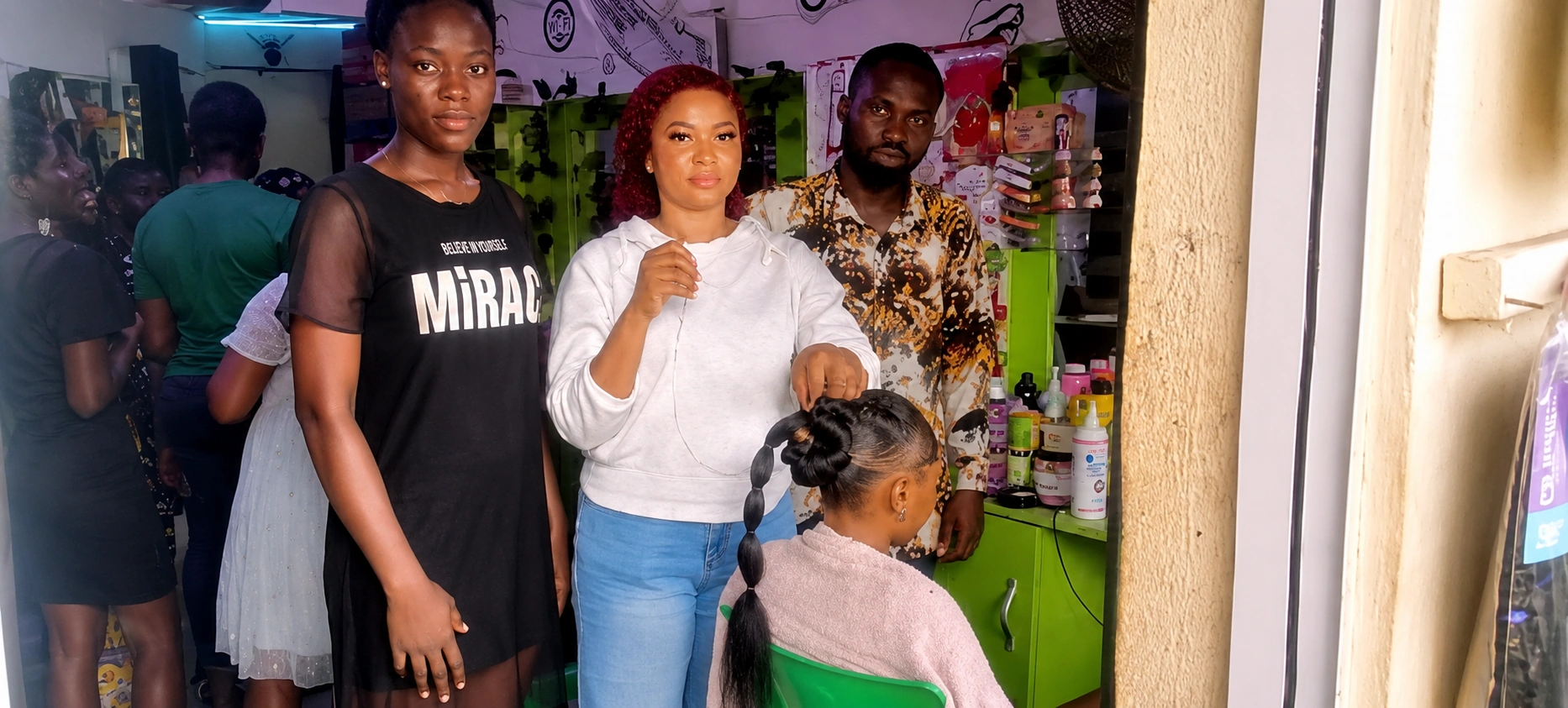
In 2025, the Foundation sponsored two Ozalla youths — Favour Nwobodo and Anastasia Ude — into formal trade apprenticeships under the Ozalla Youths Forum Skill Acquisition Program. Favour is training in shoe-making; Anastasia is learning hairdressing, makeup, and nail technology. Both were inducted with signed apprentice contracts and have begun their training.
The Ozalla Youths Forum, which coordinates the program, described the Foundation’s support as proactive and generous — a mark, they noted, of a Foundation that delivers on its word. These are not large numbers. However, every trained tradesperson is a business owner in waiting, a family stabilised, a skill that gets passed on.
In 2025, the Foundation invested ₦1,000,000 in the Aba Fashion Future Program — a competitive, government-linked fashion-training initiative. Getting our candidates selected required significant personal effort from Foundation leadership: two trips to Aba, seventeen days of on-the-ground advocacy, and direct support for candidates’ transport and accommodation until they were formally enrolled.
The result: five accepted candidates from Ozalla and one from Ugbawka, now in training in one of Nigeria’s leading fashion hubs. In 2026, the Foundation supported participants in a Future of Design graduation program, marking the completion of training for another cohort of young creatives from our communities.
The Foundation has actively connected our communities to government-sponsored technology-training opportunities, including the Enugu Magic Labs Animation Training Program (EMAT) — a partnership between the Enugu State Government and Magic City Labs, a globally recognised animation academy with clients including Disney and Netflix. The program trains young people in 3D motion design and animation at an 80% subsidised rate.
In 2025, the PNF Tech Scholars initiative disbursed ₦628,000 to support access to technology-training programs, alongside individual grants to specific beneficiaries pursuing technical and creative careers.
Beyond the numbers, we have built relationships with the Ozalla Youths Forum, with state-government training agencies, and with program providers — relationships that create a pathway, not just a one-time grant.
The Foundation intends to formalise its skills-training track, identifying partner programs across fashion, technology, healthcare, and the trades each year and selecting candidates from our communities for sponsored participation. We are developing clearer criteria for candidate selection, stronger accountability structures for grant recipients, and an alumni network so that trained graduates can serve as guides and advocates for the young people who follow them.
Sponsoring a candidate through a vocational program can cost as little as ₦100,000 — and the return, in a career launched, is incalculable. A contribution funds access to training, not charity. Donations through PNFUSA are tax-deductible for U.S. donors.